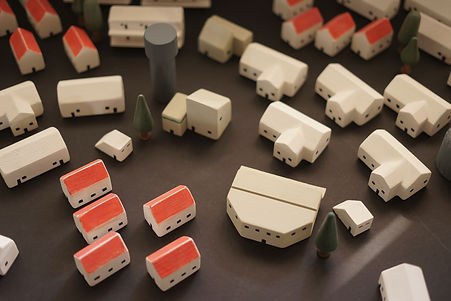
TOWER AND STOCKADE
Community-based work, wooden blocks 2.5 cm-8 cm
Kibbutz Kfar Giladi, Israel 2025
Community-Based Art program of ZUMU Museum. a social and community initiative that makes art accessible and brings it to peripheral areas across Israel.
The museum is itinerant, each time hosted in a different region, setting itself up in an unused public or communal building and responding to its specific context.
I proposed a project as an artist and educator working collaboratively with local children. In preparation for the exhibition, I met weekly with fifth-grade students at the regional school. we played, built, and asked questions together.
After World War II, several construction games were developed around the world. The massive destruction in Europe inspired the idea of offering the young generation an opportunity to build a new world, even if imaginary a world that holds hope.The concept of building with one’s own hands, embodied by the child reflects in these games the cultural and national act of creation and reconstruction.


n the weekly meetings with the children, I tried to bring them all the questions I myself have no answers to. Through their responses, I sought to shape the game, its rules and instructions, its scale, and the spirit of the children living in Israel after the war, in the year 2025.We played games of cooperation versus competition.
We formulated rules and talked about their meaning. We discussed what “home” means to them, what they believe is essential in their community, whether there should be a fence, a dining hall, trees and shade, a swimming pool, and more. Through play, drawing, and sculpting with clay, I was able to give expression to some of the children’s thoughts and imaginations.
The game consists of wooden blocks from which different models of settlements can be assembled. Each block or structure is positioned in explicit relation to its neighbors, the pathways, and the public spaces (such as a dining hall, library, water tower, shelter, or playground), responding on three layers, what exists, what is missing, and what needs to be added.The different blocks allow a reframing of roles, examining questions of home and belonging: are we building, dismantling, or imagining another way of living, in Israel in general, and in a region marked by war and conflict in particular.Visitors to the museum will be able to disassemble and reassemble the wooden blocks on the game board, placing buildings, fences, or pathways, allowing the work to continuously change, collapse, and rebuild itself through the movement of people.